StackWave Affinity™

 Protein Production

From protein request to released lot, with the data captured at every step

Affinity's Protein Production module turns expression requests into characterized, released protein lots. Requests come in from around the system, and requests for proteins with existing inventory can be filled from stock with location and remaining amounts shown. The rest move toward expression: those without a corresponding plasmid route into vector construction first, and reach expression only once the plasmid is built and verified. Standard expression takes a single construct through transfection and purification; high-throughput expression runs whole panels in parallel on plates. Every lot is reviewed against yield, concentration, purity, and endotoxin before release, and released lots land in inventory as individual aliquots with the full production record attached.

StackWave Affinity™ Protein Production Module

Protein production is a multi-week pipeline, not a single event

Producing a protein for characterization is weeks of work juggled by multiple scientists. A request gets queued, a transfection gets planned and run, the harvest gets purified, lots get reviewed against yield and purity criteria, and only then does the released material become available to downstream consumers. The data captured at each step is the basis for every later decision about whether the protein is good enough to use.

Tracking this information across spreadsheets, shared drives, and batch records that live separate from the requesting program's data can slow the entire process. When a downstream scientist pulls a vial from the freezer, the production history they need (what was the yield, how pure, was there an endotoxin issue) is somewhere else, and any lot review that flagged the batch as problematic doesn't follow the material. Affinity treats production as a tracked pipeline with distinct steps from request to expression to review to release. Data is captured at each step, and lot-level review stays attached to the ultimate aliquots everywhere they go.


Click here to download the StackWave Affinity LIMS presentation

A scientist's day, in Affinity

A request lands and the queue gets sorted

Discovery handed over an anti-CD20 panel: twenty candidates to express as full-length IgG for characterization, with the lead three jumped to the front. For the production lead, the morning starts at the request queue: what's ready to run, and what's still waiting on a plasmid or a decision.

Each request arrives carrying its context, so triage is reading what's in front of you, not chasing the requester for the details. The team lead works down the queue: the requests ready to go get separated from the ones still incomplete, the three priority constructs get peeled off for single-construct runs, and the rest of the panel stays grouped for a subsequent batch. When a request is for a protein the lab already has on hand, triage fills it straight from inventory instead of sending it to the bench, the stored aliquots and their amounts surfaced right there. Anything headed to an outside vendor is turned into an Excel order sheet based on the scientists' requests. What isn't moving forward gets cancelled with a reason that stays on the record, so the queue shows the current state of the work.

The construct moves through expression

The three priority constructs go one at a time; the panel of twenty runs as a single parallel batch. The work is the same shape either way, and it plays out over weeks at the bench. The difference is whether Affinity is following one construct or a whole plate.

A single construct moves through expression a phase at a time, and Affinity records each phase as the bench finishes it: the transfection with its cell line and volume, the purification with its method and the yield and concentration recovered, the characterization with its SEC purity and endotoxin, and the last step placing the finished protein into an inventory location. A task advances only as the data for it lands, so the queue is always a true read on where the construct is: waiting to start, in transfection, through purification, or complete. The plate-based panel of twenty runs that same arc in parallel: a single transfection step records the cell line and volume across the batch, the wells move through together, and the stragglers and failures get marked off as the batch thins out.

However the construct got made, the production data lands where the work happened, not in a record on someone's drive that the rest of the program can't see.

Every lot gets reviewed before release

Twenty expressed lots came out of HTE. Some have great yields and clean SEC traces; some have low yields or visible aggregation. The next step is reviewing each lot against the program's criteria before releasing anything to downstream characterization.

The Lot Review page puts each lot's production record next to its quality numbers, so the release call is made on the whole picture in one place. The review-status field on each lot accepts Flagged or Do Not Use values when a problem is caught, which are then displayed to scientists in Affinity, so a low-purity Flagged lot doesn't accidentally end up in a characterization assay without the reviewer's reasoning visible.

The released lot lands in inventory with its history attached

Lot review is done. The lots that passed are now first-class in inventory, ready to be pulled when the next assay batch starts.

The protein's page in the bioregistry carries the full production lineage: the construct, the cell line it was expressed in, transfection information (date, volume), the yield and concentration recovered, the SEC purity and endotoxin readings, any review-status flags applied, the request the lot originated from, the project it belongs to, and the freezer location of every aliquot. When the next scientist pulls a vial six weeks later and asks what's the production history of this lot — the answer is on one page, not a hunt across spreadsheets and emails.
How Protein Production connects to the rest of Affinity

  • Discovery is upstream: panels of candidates become protein requests for expression. The lineage from panning campaign to characterized protein stays intact.

  • Molecular Biology supports the requests that need it: when a request's construct has no expression vector yet, it routes through vector construction, and the verified plasmid feeds that request's expression run, with no re-handoff required.

  • Bioregistry is where expressed proteins register as first-class records with their production history attached.

  • Inventory is where released lots land as physical aliquots, with the lot review status and production context visible alongside the material.

  • Analysis consumes the released proteins for assay-driven characterization; assay results carry back to the production record.

  • Reporting rolls up production yields, lot review status, and pipeline throughput for program-level dashboards.

Why choose Affinity for protein production

  • The production pipeline is tracked, not narrated. Request → expression → review → release runs as a single tracked flow with per-step data capture, replacing spreadsheet- plus-email status reporting.

  • Standard and high-throughput expression on the same platform. A single-construct run and a panel-scale parallel expression share the same lineage model, with no separate batch records to reconcile.

  • Lot review with visible advisory flags. A problem caught at review doesn't get lost between teams: the Flagged or Do Not Use status renders a prominent banner on the lot's record so downstream consumers see the review decision the moment they look at the material.

  • One platform from discovery clone to released lot in inventory. Lineage is preserved at every transition.

  • Transparent pricing. $175 per user per month, every module included.

  • Founded in 2011, focused exclusively on biologics R&D.

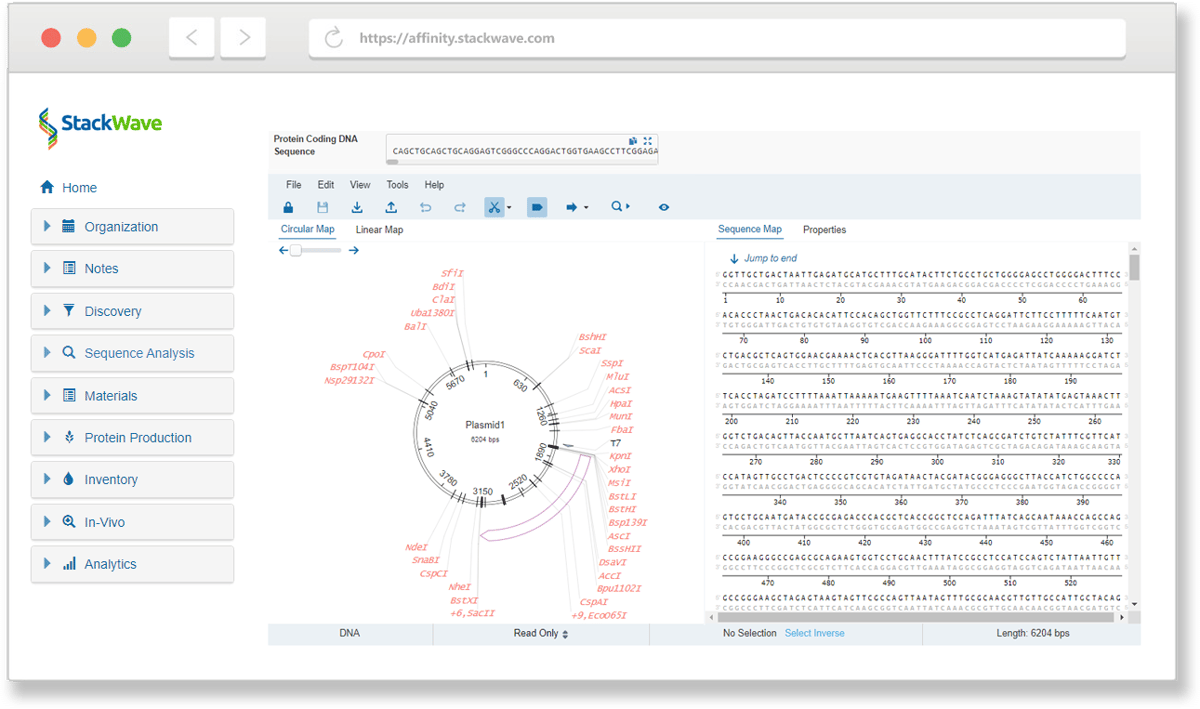
Image of plasmid circular map with restriction sites
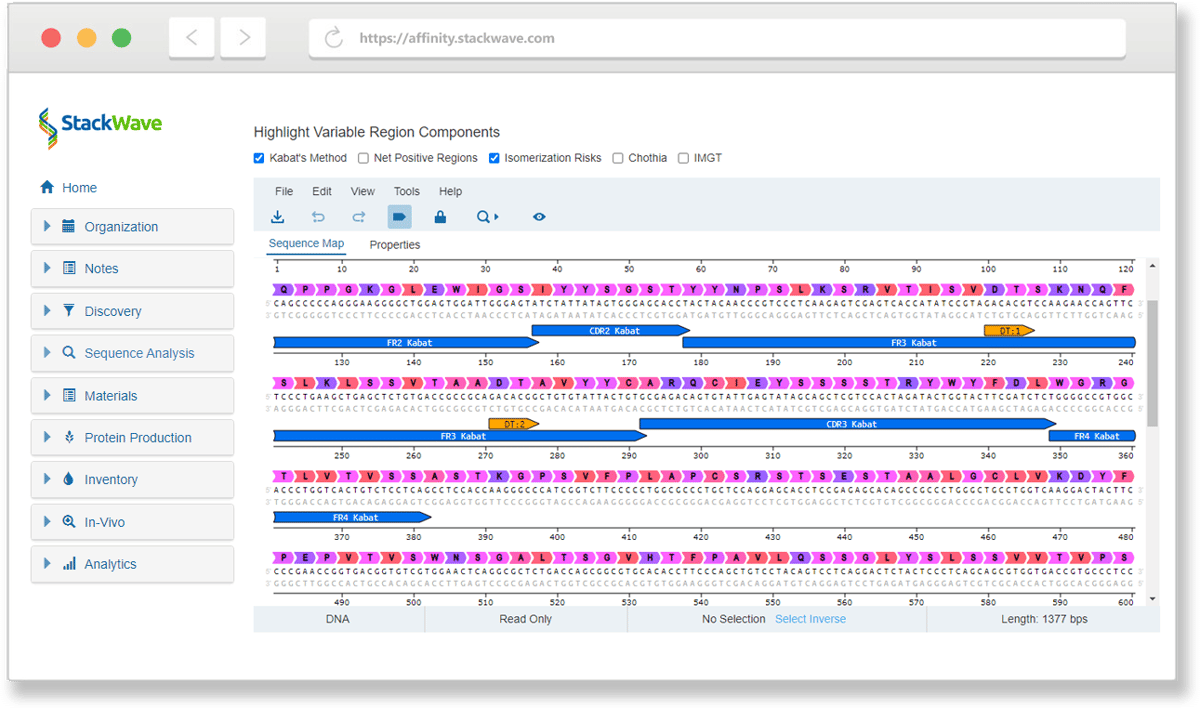
Image of antibody sequence regions
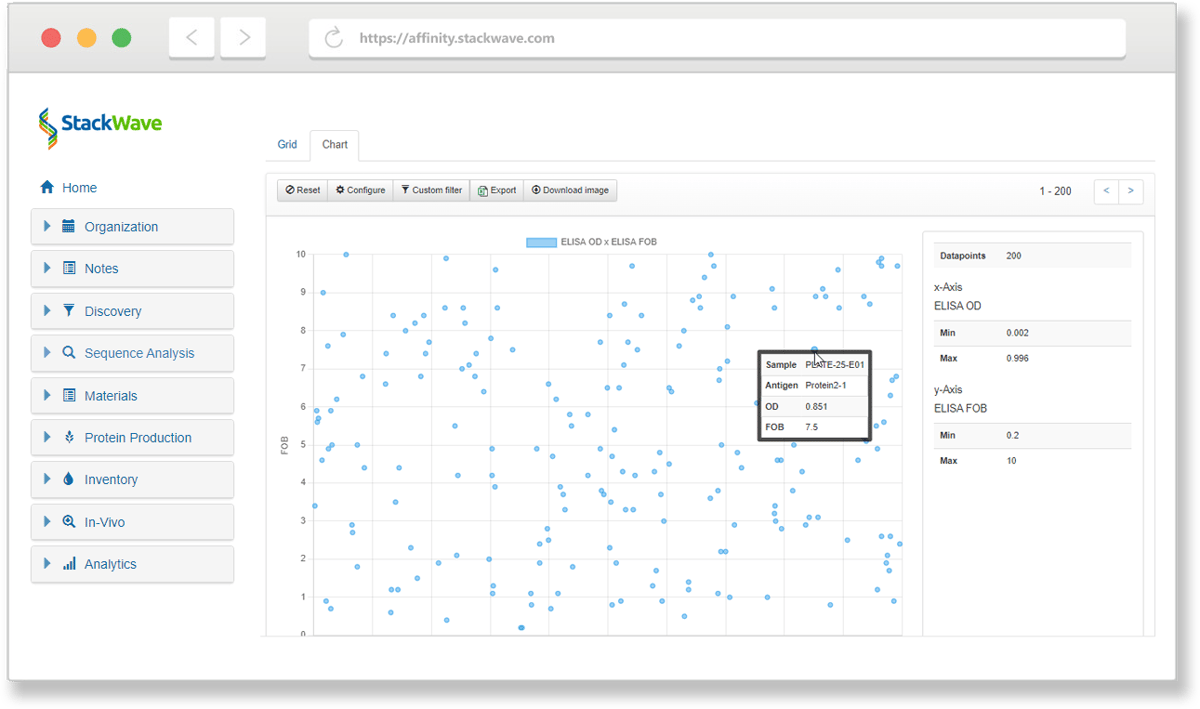
Image of clone lead identification plot
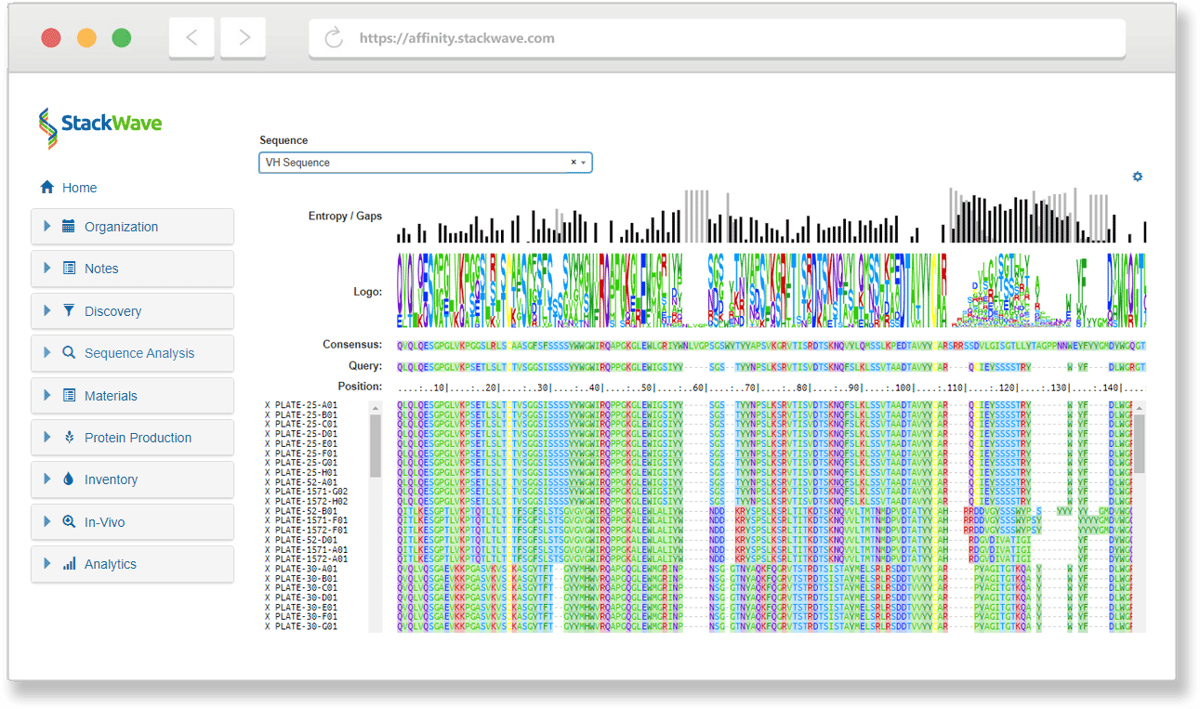
Image of sequence alignment for antibody region
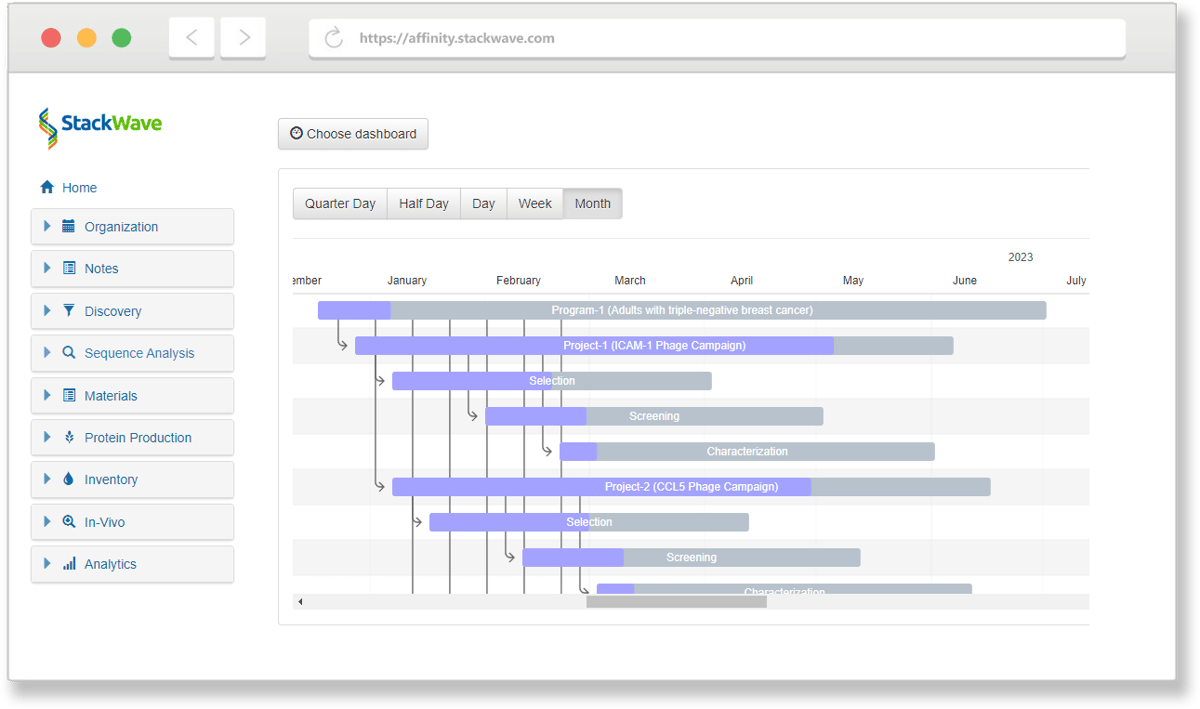
Image of operational antibody project data
Affinity in Action

Manage your entire process, from discovery to lead characterization

With Affinity, it's never been easier to collaborate effectively on drug discovery and development. Spend more of your time on discovery instead of data entry by using one solution that provides all of the tools you'll need. Request a demo or free trial today.

Collaborate

Facilitate collaboration between discovery, production, and analytics teams

Integrate

Fully integrated, from target identification to lead characterization

Consolidate

Single source of truth for all assay data

Analyze

In-depth analysis of lead antibodies

OPTIMIZE YOUR PROCESS

Learn more about our solutions for Biologics R&D

  • Sequence Analysis

  • Phage Panning

  • Lead Characterization

  • Hybridoma Production

Sequence Analysis

Leverage Affinity’s built-in sequence analysis tools to identify the unique antibodies in your discovery campaign results without having to license or build a separate bioinformatics system. Additional sequence search tools take advantage of Affinity’s sequence and variable region databases to quickly find related sequences.

Phage Panning

Phage panning allows you to narrow the enormous diversity represented by your phage libraries to a manageable set of antibodies for further study. Create visual designs of your phage panning experiment to track which combinations of antigens and other inputs produced the most promising leads. From the pools of phage output produced, generate sets of screening plates for assaying, sequencing, screening, and analysis.

Lead Characterization

StackWave Affinity provides workflows for phage, hybridoma, and single B-cell campaigns, assay data management, sequence analysis, custom reporting, and plate generation in a single solution. These tools integrate seamlessly to help discovery teams quickly identify their most promising lead antibodies. Automation support for liquid handling platforms and assay data ingest allows for high-throughput screening of campaign results.

Hybridoma Production

Manage the complexity of hybridoma campaigns with an actual animal study management solution that connects seamlessly with hybridoma plate generation. Generated plates can be screened, sequenced, filtered, and lead antibodies identified using an intuitive set of tools that combine assay data management, sequence analysis, and custom reporting.

"StackWave gives us confidence in our leads by collecting all of the data about our potential therapeutics in one place and making that data actionable by allowing us to compare antibodies of interest."

"I worked with StackWave for ~4 years at my previous job to implement our LIMS. It was a great learning experience. We put in place an incredible system for our entire workflow, from plasmid registration to in-vivo study data registration."

"StackWave’s Platform allowed us to collaborate on our in-vivo studies in a web browser at home... I would highly recommend StackWave for therapeutic discovery teams looking to improve collaboration between teams."

Get started now

One Tool for Biologics R&D