StackWave Affinity™

 ELN

The lab notebook that links to the real records, not screenshots of them

Affinity's ELN is a structured lab notebook that lives in the same platform as the work it documents. An entry can be built from simple sections, such as text and tables, or sections that embed the actual records: the antibody from the registry, the sample from inventory, the experimental result as it was measured, each one a structured, searchable entry linked back to its source rather than a screenshot pasted into a word processor Entries are numbered in their notebooks, taggable, and searchable across the whole book of work; they're signed and witnessed and tracked by a complete audit trail; and a template turns a repeated procedure into a page a scientist fills in rather than rebuilds.

StackWave Affinity™ ELN Module

A notebook kept apart from the data drifts away from the work it records

A lab notebook records what was done, what was used, and what came out, and most of that is, and should be, written: the rationale, the observations, the narrative of the day. The problem isn't the writing; it's when the writing is all there is. The notebook becomes a stand-alone document, a word-processor page where the antibody is a name typed in as a string and the result a screenshot pasted in. The moment it's written, it starts drifting from the work. The typed name doesn't point at the registered molecule, the pasted result is a flat picture, not the structured numbers, and nothing ties it back to the run that produced it. The entry can't be found later except by remembering which folder it's in.

Affinity treats the notebook as part of the platform, so the records an entry refers to live alongside it. The writing stays at the center of the entry, but other sections can capture properties of the molecule being studied or the experimental results themselves, each linked back to the source, so the write-up resolves to the things it describes rather than just naming them. The notebook becomes a first-class record of the work, wired to the rest of the data. Whatever the work is, an expression run, an in-vivo study, or a screening round, it gets written up here rather than in a separate document.


Click here to download the StackWave Affinity LIMS presentation

A scientist's day, in Affinity

You write up the day's work

A panning round just finished, and it needs to go in the notebook.

The scientist opens a new entry, starting not from a blank page but from the template the team uses for this procedure. The sections are already laid out in the order the work happens, so writing it up is filling in what changed rather than rebuilding the structure every time. An entry is composed of sections: a block of text for the rationale and the observations, and a table for the readings, each in the order the process was run. It's numbered in its notebook and stamped with its author and time the moment it's created, so the record starts as a record rather than becoming one later.

The entry links to the real record, not a picture of it

A section can embed the actual records the work is about: the antibody as it's registered, the sample pulled from inventory, or the assay result as it was measured, rather than a screenshot or a name typed in as text. What's captured is the record as it stood when the entry was written: a faithful account of what was used and seen, fixed the way a notebook entry should be. And because the notebook sits in the same platform as the registry, each captured record keeps a link back to its source, so a year on the entry still resolves to the actual molecule and run rather than a name to go hunting for. 

You sign the entry, and a witness countersigns

With the work written up, the entry is signed, and where the process calls for it, countersigned by a witness, with each signature carrying who signed and when. Underneath, every change to an entry is recorded with its author and timestamp from creation onward, so nothing is edited away quietly. The signing-and-witnessing flow and that audit trail are built into the notebook rather than reconstructed around a document store after the fact.

You find an entry months later

Later, when a run that worked needs repeating, or a lot used in a questioned assay needs tracing, the entry has to be found. Search runs across every notebook the scientist can see, or narrows to a single notebook or one entry, filtered by who wrote it, when, and the tags the team applied. Linked reagents point back to the notes in which they're found for quick reference. And an entry can stay private to its author or be shared with the team, so one notebook serves as both a personal working record and a shared one.
StackWave Affinity™ ELN Module

How the ELN connects to the rest of Affinity

  • Bioregistry — an entry's sections embed registered molecules, so the write-up links to the actual antibody, plasmid, or protein, not its name typed as text.

  • Inventory — the samples and lots referenced in an entry trace back to the physical material on the shelf.

  • Analysis — an entry can embed assay results as they were measured; the analysis itself runs in the Analysis module, and the notebook documents and links to it rather than re-deriving it.

  • Discovery and Protein Production — the campaigns, expression runs, and characterization work recorded across the platform are what notebook entries write up; the entry ties the narrative to the records the work produced.

StackWave Affinity™ ELN Module

Why choose Affinity for your ELN

  • A notebook connected to the registry, not a folder of documents. Entries embed the real molecules, samples, and results, so the write-up stays wired to the data instead of drifting into screenshots.

  • Signed, witnessed, and audit-tracked. Electronic signatures, witnessing, and an audit trail are native to the notebook, not layered on a document store.

  • Findable later. Search spans every notebook by author, date, and tag, and extracts as much text as possible from scanned pages.

  • Templates make the routine routine. A repeated procedure becomes a page the scientist fills in, identical every time, rather than one rebuilt from memory.

  • Transparent pricing. $175 per user per month, every module included.

  • Founded in 2011, focused exclusively on biologics R&D.

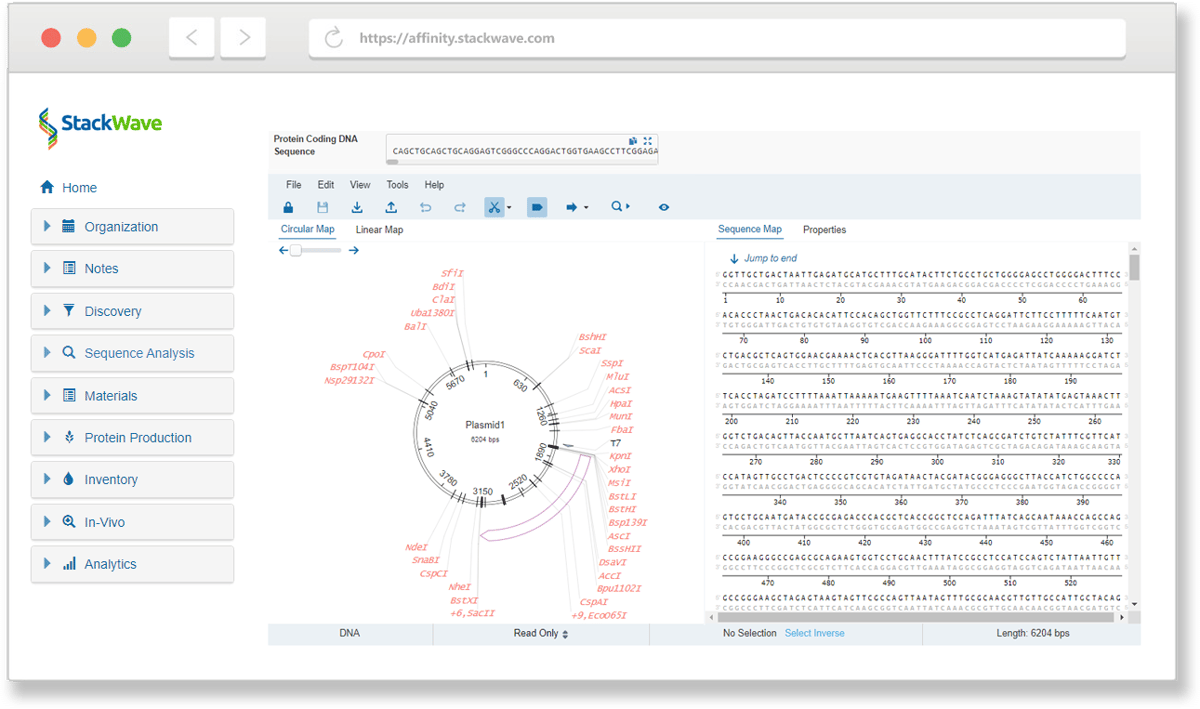
Image of plasmid circular map with restriction sites
Image of antibody sequence regions
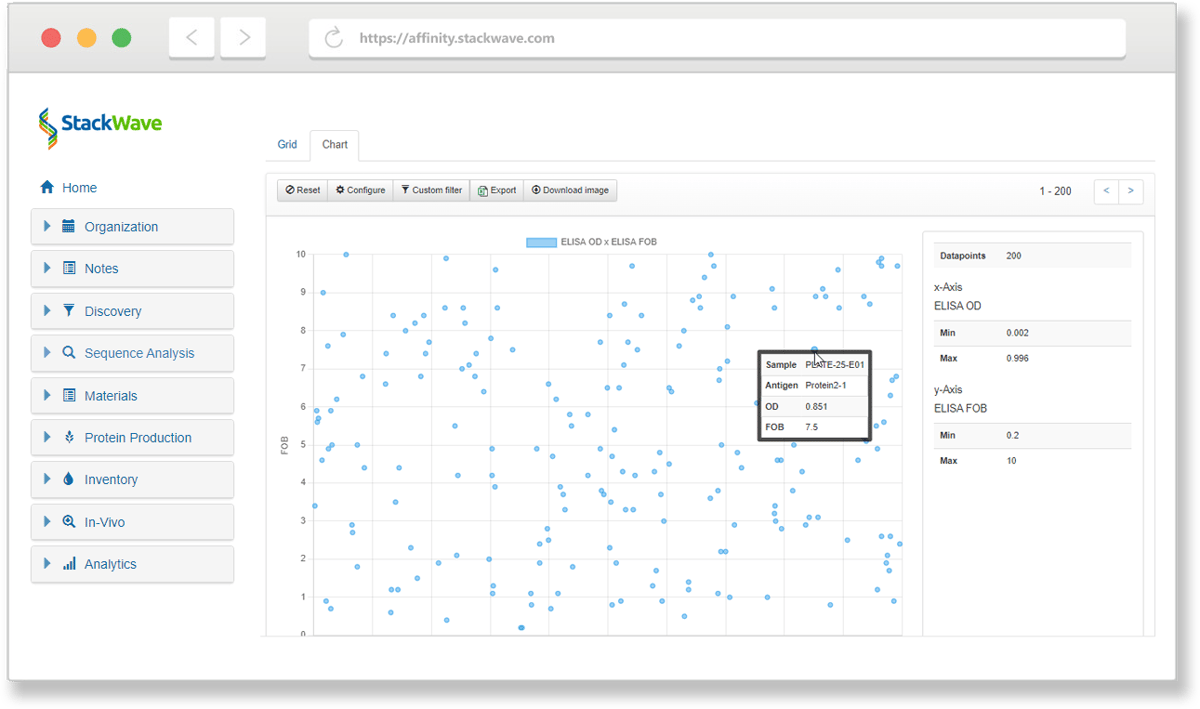
Image of clone lead identification plot
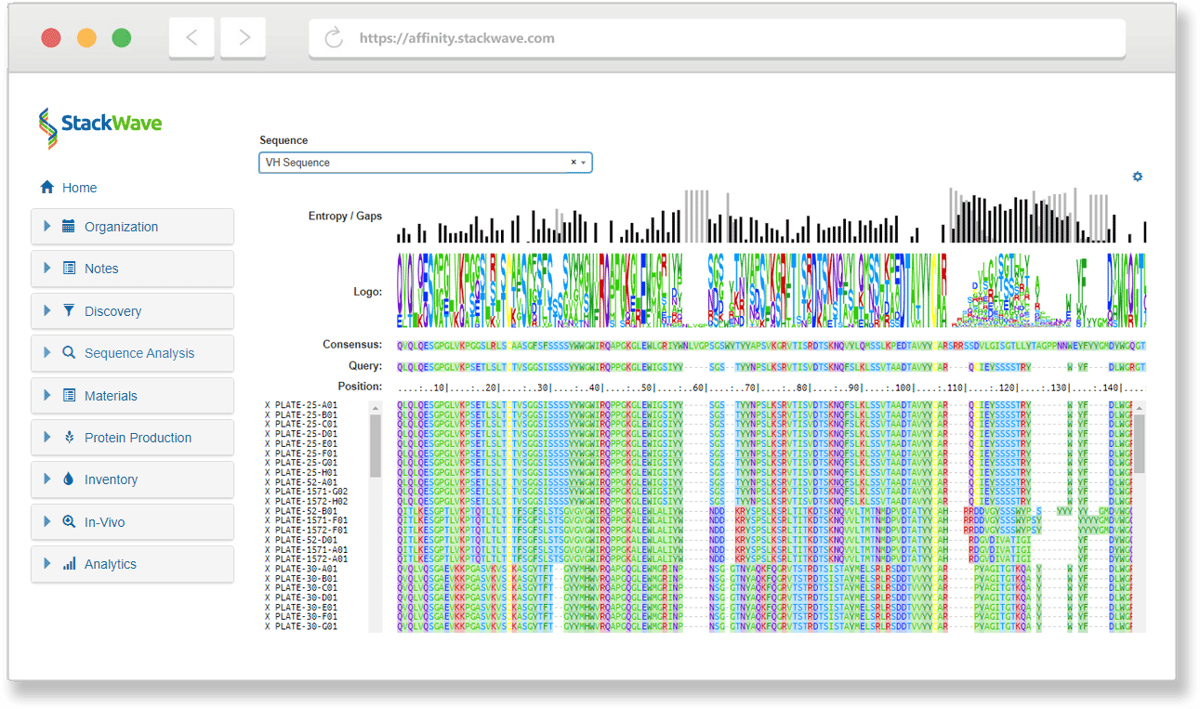
Image of sequence alignment for antibody region
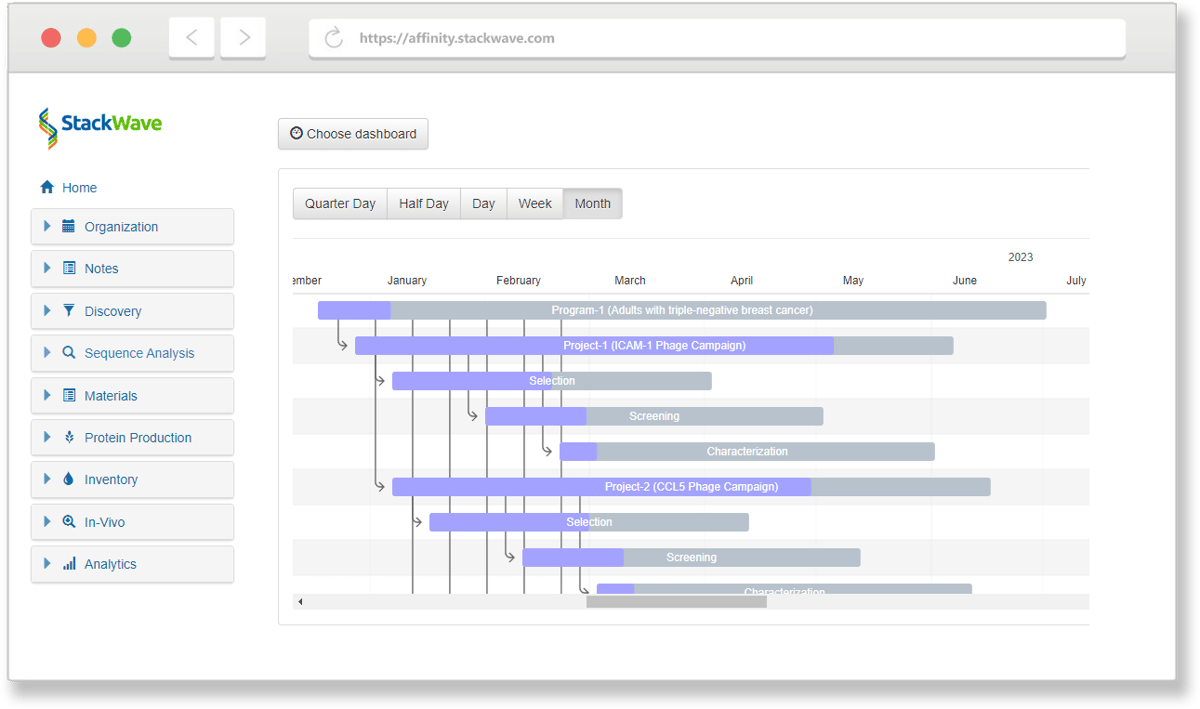
Image of operational antibody project data
Affinity in Action

Manage your entire process, from discovery to lead characterization

With Affinity, it's never been easier to collaborate effectively on drug discovery and development. Spend more of your time on discovery instead of data entry by using one solution that provides all of the tools you'll need. Request a demo or free trial today.

Collaborate

Facilitate collaboration between discovery, production, and analytics teams

Integrate

Fully integrated, from target identification to lead characterization

Consolidate

Single source of truth for all assay data

Analyze

In-depth analysis of lead antibodies

OPTIMIZE YOUR PROCESS

Learn more about our solutions for Biologics R&D

  • Sequence Analysis

  • Phage Panning

  • Lead Characterization

  • Hybridoma Production

Sequence Analysis

Leverage Affinity’s built-in sequence analysis tools to identify the unique antibodies in your discovery campaign results without having to license or build a separate bioinformatics system. Additional sequence search tools take advantage of Affinity’s sequence and variable region databases to quickly find related sequences.

Phage Panning

Phage panning allows you to narrow the enormous diversity represented by your phage libraries to a manageable set of antibodies for further study. Create visual designs of your phage panning experiment to track which combinations of antigens and other inputs produced the most promising leads. From the pools of phage output produced, generate sets of screening plates for assaying, sequencing, screening, and analysis.

Lead Characterization

StackWave Affinity provides workflows for phage, hybridoma, and single B-cell campaigns, assay data management, sequence analysis, custom reporting, and plate generation in a single solution. These tools integrate seamlessly to help discovery teams quickly identify their most promising lead antibodies. Automation support for liquid handling platforms and assay data ingest allows for high-throughput screening of campaign results.

Hybridoma Production

Manage the complexity of hybridoma campaigns with an actual animal study management solution that connects seamlessly with hybridoma plate generation. Generated plates can be screened, sequenced, filtered, and lead antibodies identified using an intuitive set of tools that combine assay data management, sequence analysis, and custom reporting.

"StackWave gives us confidence in our leads by collecting all of the data about our potential therapeutics in one place and making that data actionable by allowing us to compare antibodies of interest."

"I worked with StackWave for ~4 years at my previous job to implement our LIMS. It was a great learning experience. We put in place an incredible system for our entire workflow, from plasmid registration to in-vivo study data registration."

"StackWave’s Platform allowed us to collaborate on our in-vivo studies in a web browser at home... I would highly recommend StackWave for therapeutic discovery teams looking to improve collaboration between teams."

Get started now

One Tool for Biologics R&D