Bioregistry
Antibodies, plasmids, and novel therapeutic formats, all in one registry and sequence-aware from the moment they're registered
Affinity's Bioregistry is where everything your team builds gets recorded: antibodies, nanobodies, scFvs, fusion proteins, bispecifics, ADCs, plasmids, oligonucleotides, small-molecule payloads, cell lines. Every registration knows what kind of biomolecule it is, runs the appropriate sequence analysis, and surfaces the information the next scientist will need.
Built for the way biologics teams actually register
A biologics R&D team's bench output is not uniform. A discovery campaign produces clones with paired heavy and light chains. A molecular biology workflow produces plasmids with annotated features. A protein production run produces characterized proteins with measured yields. An ADC program adds small- molecule payloads conjugated to antibodies. Every one of these is a different shape of registration, with different information to capture and different downstream work to support.
Register an antibody in Affinity and it lands as a biological object, not a text record: its variable domains identified, its CDRs annotated, and its heavy and light chains recorded as the sequences that uniquely identify the antibody, with no schema to configure first. Registering the same sequences again resolves to the same antibody rather than creating a duplicate record. None of that is domain modeling the team builds for itself; it ships with the platform. Registration meets each molecule on its own terms, with a distinct path for antibodies, nanobodies, scFvs, plasmids, oligonucleotides, and more, each capturing what that molecule needs. The reagents and consumables a lab stocks, from buffers to kits, register through a general path under your own categories. The registry covers what you build and what you build it with.
Click here to download the StackWave Affinity LIMS presentation
You register an antibody from a discovery campaign
A panning campaign produced a set of clones. Heavy and light chain pairs were called from sequencing. You're ready to register the panel as antibodies.
Registration meets the input you already have. Affinity offers several paths, each matched to how the work actually arrived: from existing clones, from plasmids, from sequence files, or from registered variable domains. The panel registers from whatever the campaign produced, rather than being retyped to fit one form.
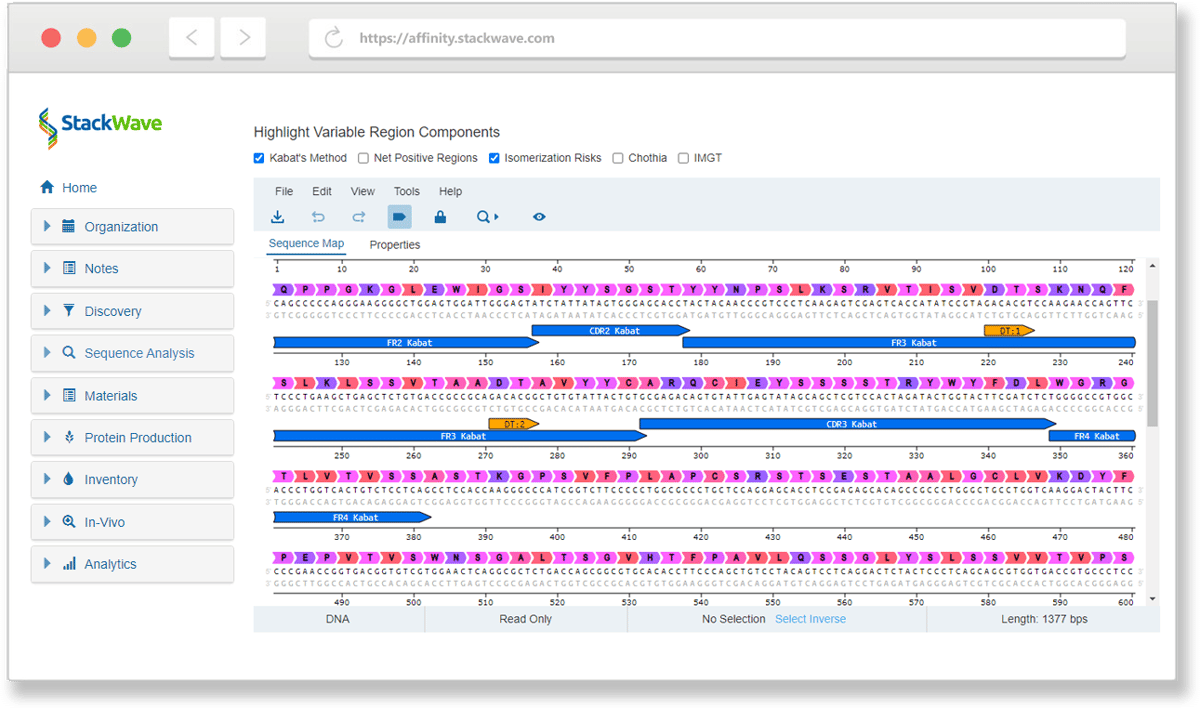
Whatever the path, sequence analysis runs at registration time. Variable regions get identified. CDRs get annotated. Isotype information is captured per the path: a from-clones registration carries the isotype mapping through the format, while sequence-based paths capture the constant regions from the sequences. Heavy and light chains land as paired records, and the antibody's page shows each chain's sequence with the variable region annotated.
Engineered formats — bispecifics, trispecifics, T-cell engagers, Fc fusions — register the same way, tuned to the shape: from plasmids, from sequences, or from clones, with the component chains landing alongside the assembled construct.
You design a new format for a novel construct
A program is building a new molecule that doesn't fit your existing therapeutic formats. A tri-specific T-cell engager with a novel linker arrangement, for example.
When no existing shape fits, you design one. Build the format from its chain sequences and parts in a guided form, or draw it as a diagram. Drop in heavy and light chain variable regions, constant region domains, linkers, T-cell receptor segments, peptides, antigens, or any protein sequence already in the registry, link them into the format you're after, and it becomes a first-class shape that subsequent registrations populate with specific sequences.
The catalog of parts for populating your formats is the bioregistry's own: all of the variable and constant domains, linker sequences, signal sequences, or any other part you create. So a format you design uses the same primitives the rest of your team's work already builds on.
You inspect a candidate's full picture
You want to look at the lead antibody from last week's panel: what it binds, what its chains look like, what experiments it's been in.
The antibody's page pulls the whole picture together: the campaign from which it came, the clone from which it was isolated, its biophysical properties and experimental measurements, the targets it binds, the ELN entries in which it appears, and all of its inventory, alongside its sequences with annotated variable domains and links to matching plasmids. The page is built around the antibody as a biological object, not as a generic row.
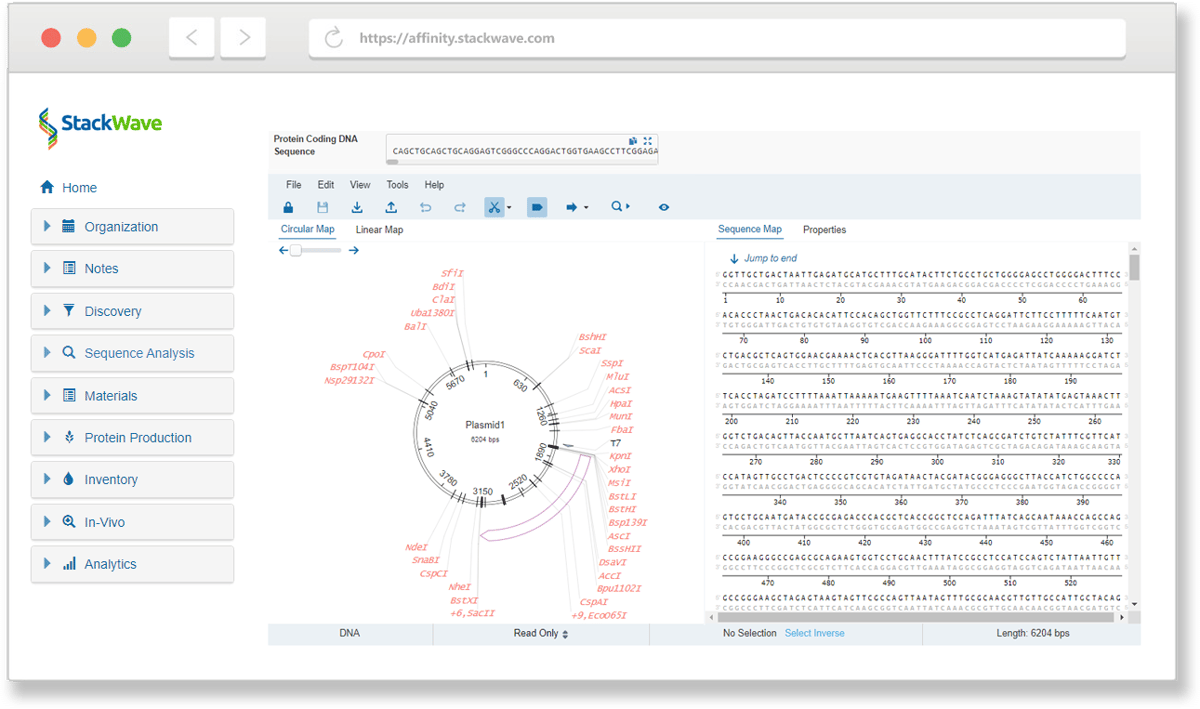
A plasmid's page does the same job: in addition to project, matching proteins, inventory, ELN entries, and experimental results, the sequence is rendered as a circular map in an embedded vector visualization, with features, signal sequences, coding sequences, and primers shown as annotations on the loop. Toggle the highlight overlays to focus on a specific annotation.
You group candidates for side-by-side analysis
A program lead asked for a comparison of the top ten anti-CD20 antibodies across binding, expression yield, and developability metrics.
The candidates you want to compare can be grouped into a named set that joins your team's other sets in the registry. From there the set opens into a comparison view, its candidates lined up across whichever assay results, scoring metrics, or sequence features matter for the question being asked. Grouping works across every therapeutic format, and a set can mix formats when the question crosses categories: proteins, conjugates, scFvs, nanobodies, or a format your team designed.
You bring in a small-molecule payload
For an ADC program, you need to register the payload chemistry alongside the antibody it conjugates to.
Small molecules register two ways: paste SMILES strings, or draw the structure in the embedded sketcher. Either way the SMILES is what's persisted, so downstream computational work has a clean structure handle, and the conjugate links the protein component to the small-molecule one.
You log the rest of the bench's reagents
Not everything in the lab is a biologic. A program also runs on buffers, media, enzymes, and assay kits: things that don't carry a sequence but still need a record, a project to belong to, and a place in inventory.
Register any of these through a generic reagent path: a name, a short description, and a reagent category your team has set up. It lands in the same registry as the antibodies and plasmids, scoped to its project and ready to track in inventory alongside everything else the registry knows about.
How Bioregistry connects to the rest of Affinity
The Bioregistry is the spine the other modules attach to.
-
Planning scopes every registration to a project and a target. An antibody registered against a target automatically shows up under any project pursuing that target.
-
Discovery produces the clones that the antibody registration consumes; the lineage from panning round to registered antibody stays connected.
-
Molecular Biology produces the plasmids the registry tracks; vector design, sequence verification, and cloning flow through here.
-
Protein Production consumes the candidates registered here as protein requests, runs expression, and ships the resulting proteins back to the registry with their yield captured.
-
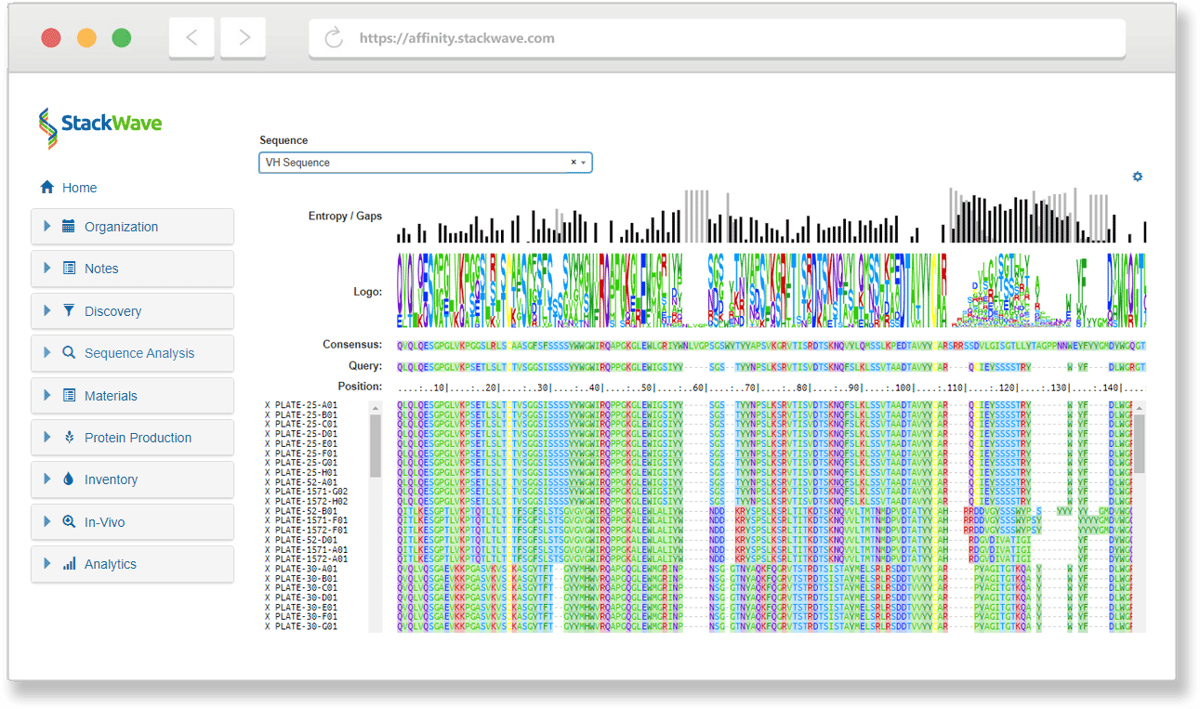
Analysis reads every registration and surfaces sequence search, BLAST, and multiple sequence alignment across the whole bioregistry's protein and DNA content.
-
Inventory holds the physical lots and aliquots of the candidates the registry knows about. A vial pulled from the freezer is always traceable back to its bioregistry record.
Why choose Affinity for bioregistry
-
Built for biologics, and built to be complete. Separate registration paths for antibodies, nanobodies, scFvs, proteins, plasmids, oligonucleotides, chemicals, and cell lines, each with the information that kind of biomolecule needs, not a generic form retrofitted ten ways, plus a path for everything else the bench tracks. Nothing your team works with falls outside the registry.
-
Sequence-aware on registration. Variable regions, CDRs, isotype identification, and signal sequence detection all run at registration time. The information is there the moment you need it.
-
A format designer for novel constructs. Draw new biomolecule shapes from a parts catalog of variable regions, constant regions, hinges, linkers, and TCR segments. New formats become first-class shapes the rest of the system uses.
-
Transparent pricing. $175 per user per month, every module included.
-
Founded in 2011, focused exclusively on biologics R&D. The shapes above were built for the workflows scientists actually run, not generalized from an adjacent industry.
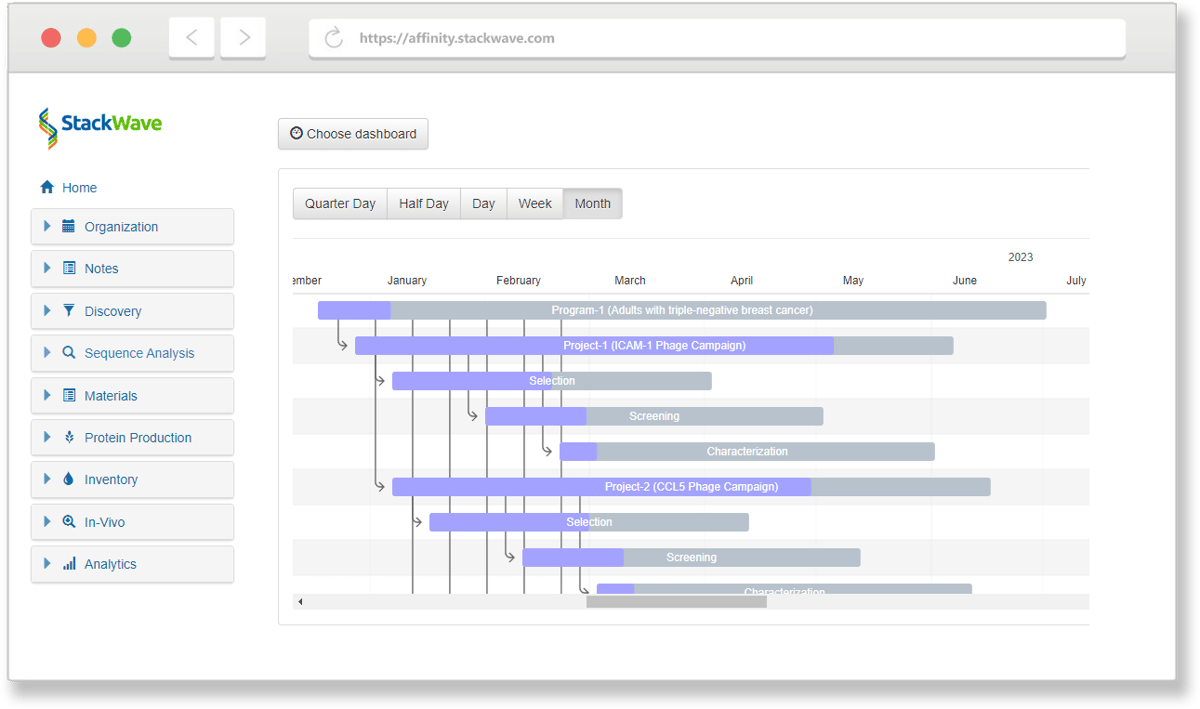
Manage your entire process, from discovery to lead characterization
With Affinity, it's never been easier to collaborate effectively on drug discovery and development. Spend more of your time on discovery instead of data entry by using one solution that provides all of the tools you'll need. Request a demo or free trial today.
Collaborate
Facilitate collaboration between discovery, production, and analytics teams
Integrate
Fully integrated, from target identification to lead characterization
Consolidate
Single source of truth for all assay data
Analyze
In-depth analysis of lead antibodies
Learn more about our solutions for Biologics R&D
-
Sequence Analysis
-
Phage Panning
-
Lead Characterization
-
Hybridoma Production
Sequence Analysis
Leverage Affinity’s built-in sequence analysis tools to identify the unique antibodies in your discovery campaign results without having to license or build a separate bioinformatics system. Additional sequence search tools take advantage of Affinity’s sequence and variable region databases to quickly find related sequences.
Phage Panning
Phage panning allows you to narrow the enormous diversity represented by your phage libraries to a manageable set of antibodies for further study. Create visual designs of your phage panning experiment to track which combinations of antigens and other inputs produced the most promising leads. From the pools of phage output produced, generate sets of screening plates for assaying, sequencing, screening, and analysis.
Lead Characterization
StackWave Affinity provides workflows for phage, hybridoma, and single B-cell campaigns, assay data management, sequence analysis, custom reporting, and plate generation in a single solution. These tools integrate seamlessly to help discovery teams quickly identify their most promising lead antibodies. Automation support for liquid handling platforms and assay data ingest allows for high-throughput screening of campaign results.
Hybridoma Production
Manage the complexity of hybridoma campaigns with an actual animal study management solution that connects seamlessly with hybridoma plate generation. Generated plates can be screened, sequenced, filtered, and lead antibodies identified using an intuitive set of tools that combine assay data management, sequence analysis, and custom reporting.
"StackWave gives us confidence in our leads by collecting all of the data about our potential therapeutics in one place and making that data actionable by allowing us to compare antibodies of interest."
"I worked with StackWave for ~4 years at my previous job to implement our LIMS. It was a great learning experience. We put in place an incredible system for our entire workflow, from plasmid registration to in-vivo study data registration."
"StackWave’s Platform allowed us to collaborate on our in-vivo studies in a web browser at home... I would highly recommend StackWave for therapeutic discovery teams looking to improve collaboration between teams."