Protein Engineering
Multispecifics, ADCs, and the engineered formats your program actually runs
Affinity's Protein Engineering module is where engineered biologics get designed, registered, and evaluated. Multi-chain formats come together in a draggable diagram designer with a parts catalog of variable domains, constant regions, linkers, and TCR segments, enabling the design of bispecifics, trispecifics, T-cell engagers, protein fusions, or any other format your team devises. ADC programs register their payload chemistry alongside the antibody component as a composite conjugate. Build a panel for each format and line the panels up side by side on one dashboard, comparing the candidates on the criteria that decide the call: binding, expression, and sequence liabilities. Weigh them with a scoring profile or read the columns directly; either way the program-review question of should we move this forward as an IgG, an scFv, or a bispecific is answered from the data rather than by consensus.
An engineered biologic is more than a list of its parts
A bispecific has two arms with two different specificities. A T-cell engager binds an effector cell on one arm and a target cell on the other. A protein fusion affixes a non-antibody domain to a constant region. An ADC joins a small-molecule payload to an antibody through a linker. What makes each of these what it is isn't the parts on their own, it's how they're put together: which chain is which, how the chains pair, which payload is conjugated to which antibody.
A system that records only the parts keeps the sequences and the chemical structures but loses how they connect. A multi-chain format becomes a bag of sequences with nothing marking which arm binds what; an ADC becomes an antibody in one record and a payload in another, with the link between them left in the scientist's head or on a slide. Evaluation then collapses to "antibodies vs. variants," with no way to line one format up against another.
Affinity keeps those connections in the platform. Multi-chain formats are laid out in a designer that captures the architecture, so every construct built on a format inherits its shape rather than restating it. An ADC registers as one composite, joining the antibody, payload, and linker in a single conjugate record with the line back to the source clone intact, so it stays one molecule the platform tracks rather than two records a scientist has to remember are related.
Click here to download the StackWave Affinity LIMS presentation
You design a novel format
A program is building a bispecific T-cell engager against CD20 and CD3. The shape doesn't fit your team's existing antibody or scFv format catalog; it's a new format the program will run multiple constructs in.
The engineer defines the format on Affinity's format diagram canvas, then generates a panel of bispecific TCEs in the format the diagram describes by plugging in parts from the built-in catalog: the same variable domains, constant regions, linkers, and hinges the team's other engineered work is built from, not a free-text description standing in for them. What the engineer lays out once becomes a reusable format: every bispecific the program registers against it inherits the architecture, so the twenty constructs that follow are all the same defined shape rather than twenty hand-assembled one-offs.
You assemble an ADC
The next construct in the program is an ADC version of the lead anti-CD20 antibody, an antibody-payload conjugate with a cleavable linker carrying a tubulin-disrupting cytotoxic warhead.
The engineer first draws the cytotoxic warhead using the built-in chemical structure sketcher, then registers a panel of ADCs using different linkers to connect the payload to the lead antibody. Now registered as a conjugate, the ADC is a single composite the platform reasons about as one molecule, with the antibody, payload, and linker connected together in one record. The warhead's chemistry the antibody's sequence, even the line back to the source clone are all traceable from one place. The ADC isn't multiple records that a scientist has to remember are related; it's the molecule, whole, with its lineage intact.
You build a panel from engineered constructs
The program wants twenty bispecific constructs moving forward into characterization. The bispecific format defined earlier needs to be populated with specific variable-domain pairs from the team's anti-CD20 and anti-CD3 panels.
A panel is how the engineer turns the abstract format into those twenty constructs: the paired variable domains coming off clone identification slot into the format's arms, so what the panel holds isn't a list of picked clones but a set of assembled bispecifics in the format the program chose, traceable back to their origin out of discovery.
Which domains go in is a filtering question, and the engineer narrows the discovery output the way the decision actually runs: by evaluating binding affinity, development liabilities, V-gene usage, and other key metrics. Alternatively, the engineer starts from a set of binders that the team already curated. In either case, the panel that comes out carries forward into vector construction, expression, characterization, and reporting as one named group that the rest of the program works against.
You compare formats side by side
The program needs to decide whether the lead anti-CD20 candidate should advance as an IgG, an scFv, or a bispecific T-cell engager — three different formats carrying the same set of underlying variable domains. The question isn't which single candidate is best; it's which format is best.
The engineer builds the same underlying domains into three panels: one IgG, one scFv, one bispecific. The panels are each scored against the program's agreed profile, with binding, expression, stability, and liabilities all weighted the way the program decided. Ranked on a dashboard side by side, the three formats stop being a matter of opinion; the IgG panel's leaders sit next to the bispecific panel's leaders on the same criteria, and the format call is read off the data rather than argued to consensus.
Formats rarely survive the first pass intact, and revising one doesn't overwrite it: dropping the format that underperforms or adding a new variant arm spins off a derived panel that keeps its parent's lineage. Every format the program tried stays on the record, so months later, why did we drop the trispecific? is a question with an answer, not a memory.
How Protein Engineering connects to the rest of Affinity
-
Bioregistry holds the parts catalog the diagram designer draws from (variable domains, constant regions, linkers, hinges, signal sequences) and is where every engineered construct registers as a first-class record.
-
Discovery produces the clones whose paired variable domains populate engineered formats; the cross-format panel comparison closes the loop back to discovery decisions.
-
Molecular Biology takes designed engineered formats and runs them through the vector construction pipeline; the format definition translates into the bench work.
-
Protein Production expresses the engineered constructs; the production data attaches to the conjugate or multispecific in the same way it does to monoclonals.
-
Analysis compares engineered constructs across formats: the side-by-side candidate analysis and the assay, sequence, and property columns it reads, plus the scoring profiles a program applies when it wants the formats weighed into a single rank.
-
Reporting hosts the dashboards that roll up cross-panel comparisons and the side-by-side comparison view that composes sequences, assay results, and scoring across the engineered candidate set.
Why choose Affinity for protein engineering
-
Native multispecific support, not a retrofit. The diagram designer was built for multi-chain shapes from day one, so bispecifics, T-cell engagers, and the formats your team invents come together from the same parts catalog and register as first-class constructs with their component chains intact.
-
ADC support as a first-class composite. Payload chemistry registers alongside the antibody; the conjugate is a first-class object, not two records the user has to mentally join. The toxin catalog feeds the conjugate work directly.
-
Format-aware panels for cross-modality comparison. Build one panel per format and compare across panels through dashboards, so the program-review question is answered without spreadsheet reconciliation.
-
One platform from clone to engineered candidate to inventory. Lineage is preserved end-to-end across the engineered format's lifecycle.
-
Transparent pricing. $175/user/mo, every module included.
-
Founded in 2011, focused exclusively on biologics R&D — more than a decade of building for the engineered-format workflows.
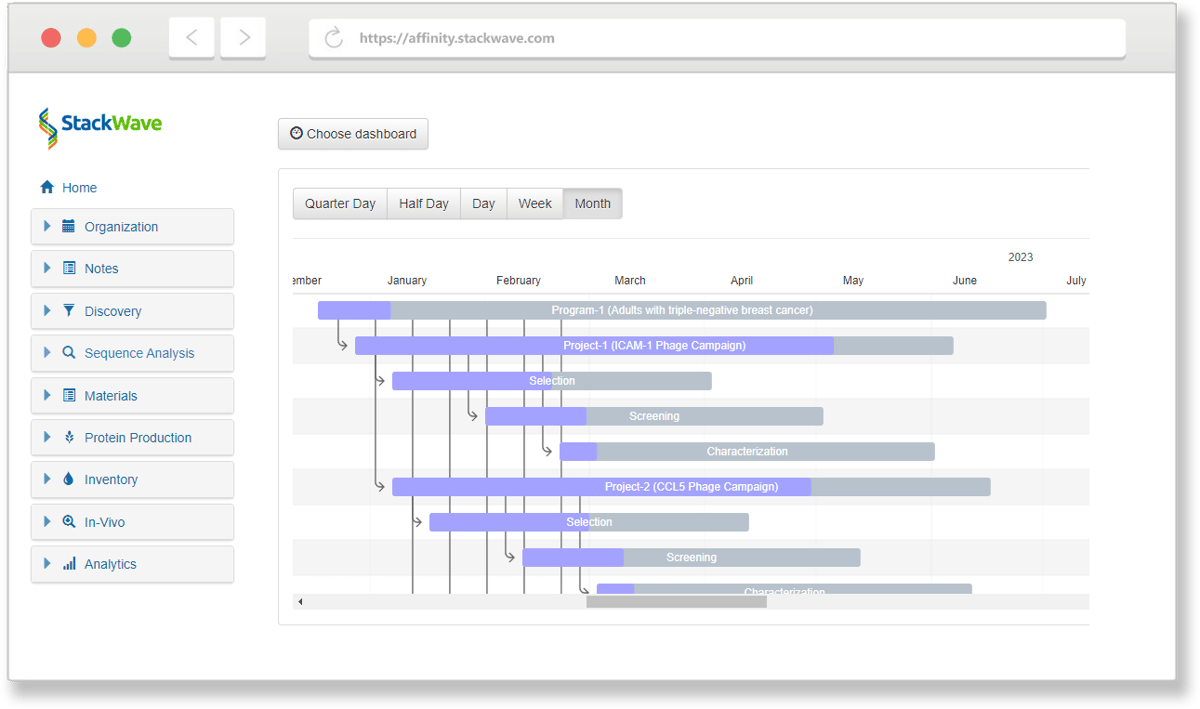
Manage your entire process, from discovery to lead characterization
With Affinity, it's never been easier to collaborate effectively on drug discovery and development. Spend more of your time on discovery instead of data entry by using one solution that provides all of the tools you'll need. Request a demo or free trial today.
Collaborate
Facilitate collaboration between discovery, production, and analytics teams
Integrate
Fully integrated, from target identification to lead characterization
Consolidate
Single source of truth for all assay data
Analyze
In-depth analysis of lead antibodies
Learn more about our solutions for Biologics R&D
-
Sequence Analysis
-
Phage Panning
-
Lead Characterization
-
Hybridoma Production
Sequence Analysis
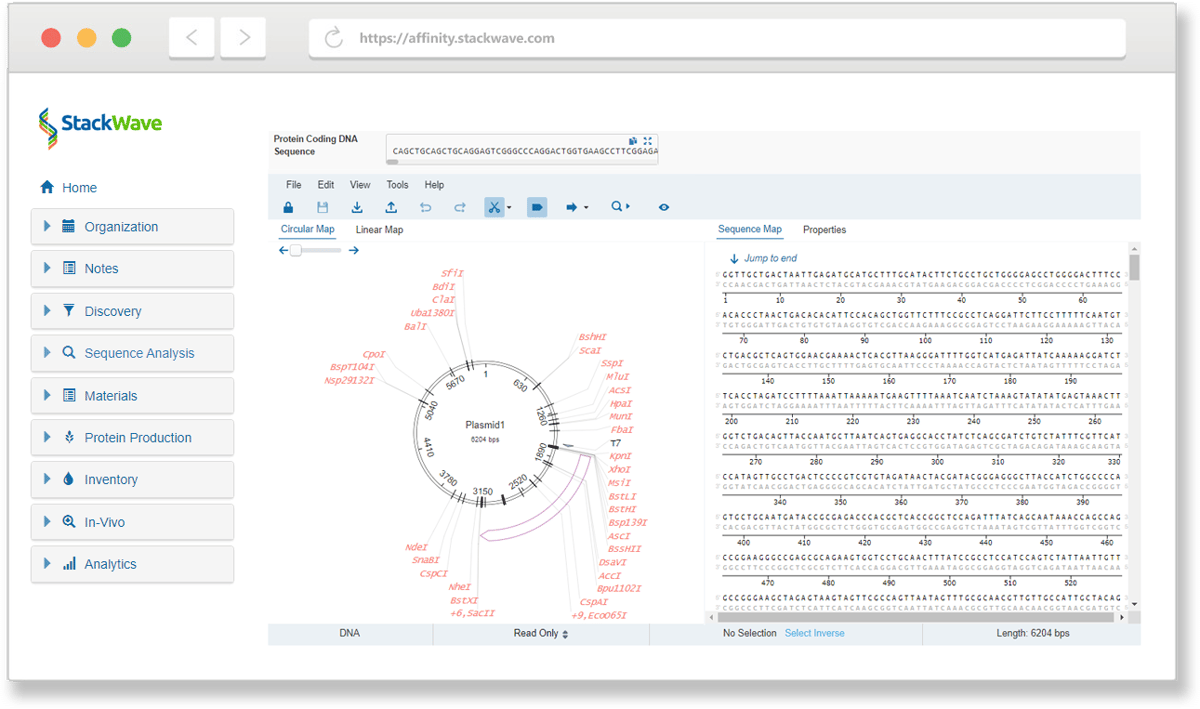
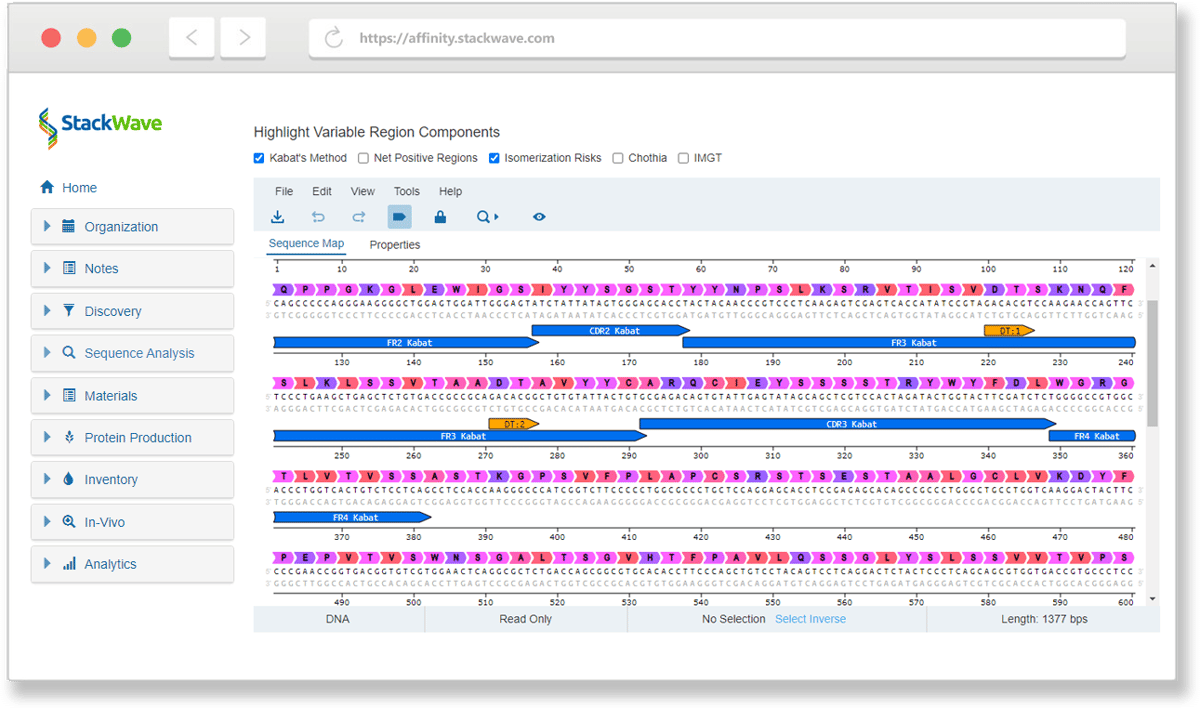
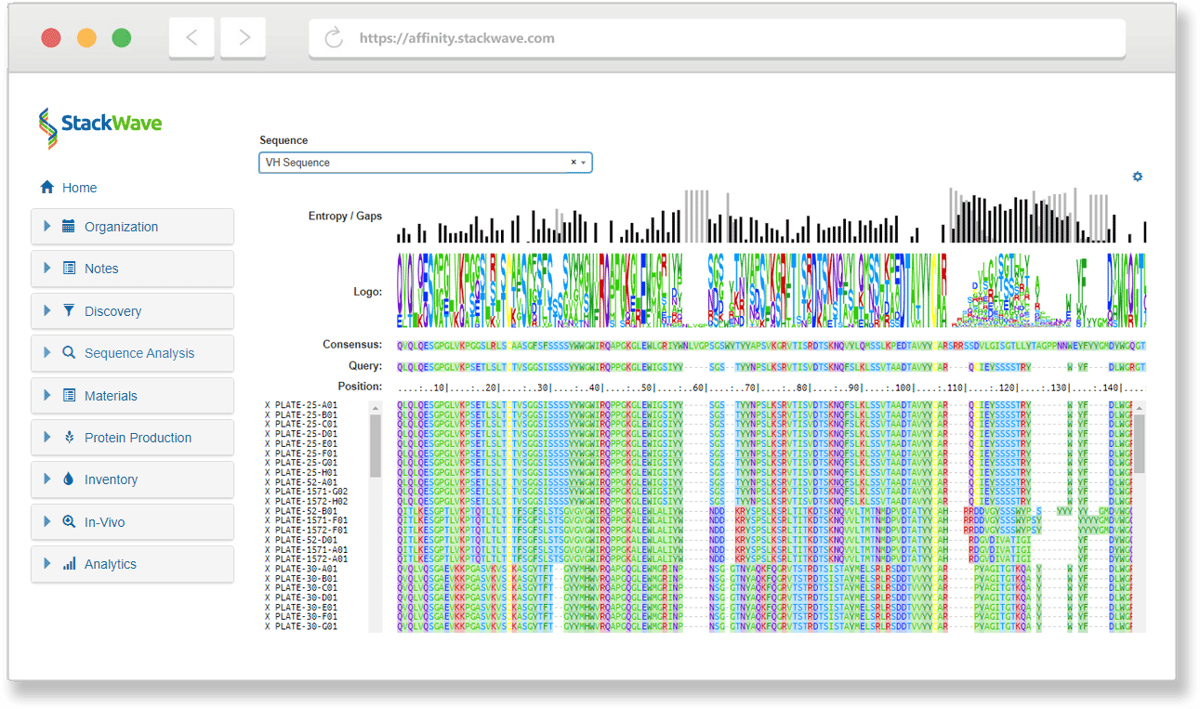
Leverage Affinity’s built-in sequence analysis tools to identify the unique antibodies in your discovery campaign results without having to license or build a separate bioinformatics system. Additional sequence search tools take advantage of Affinity’s sequence and variable region databases to quickly find related sequences.
Phage Panning
Phage panning allows you to narrow the enormous diversity represented by your phage libraries to a manageable set of antibodies for further study. Create visual designs of your phage panning experiment to track which combinations of antigens and other inputs produced the most promising leads. From the pools of phage output produced, generate sets of screening plates for assaying, sequencing, screening, and analysis.
Lead Characterization
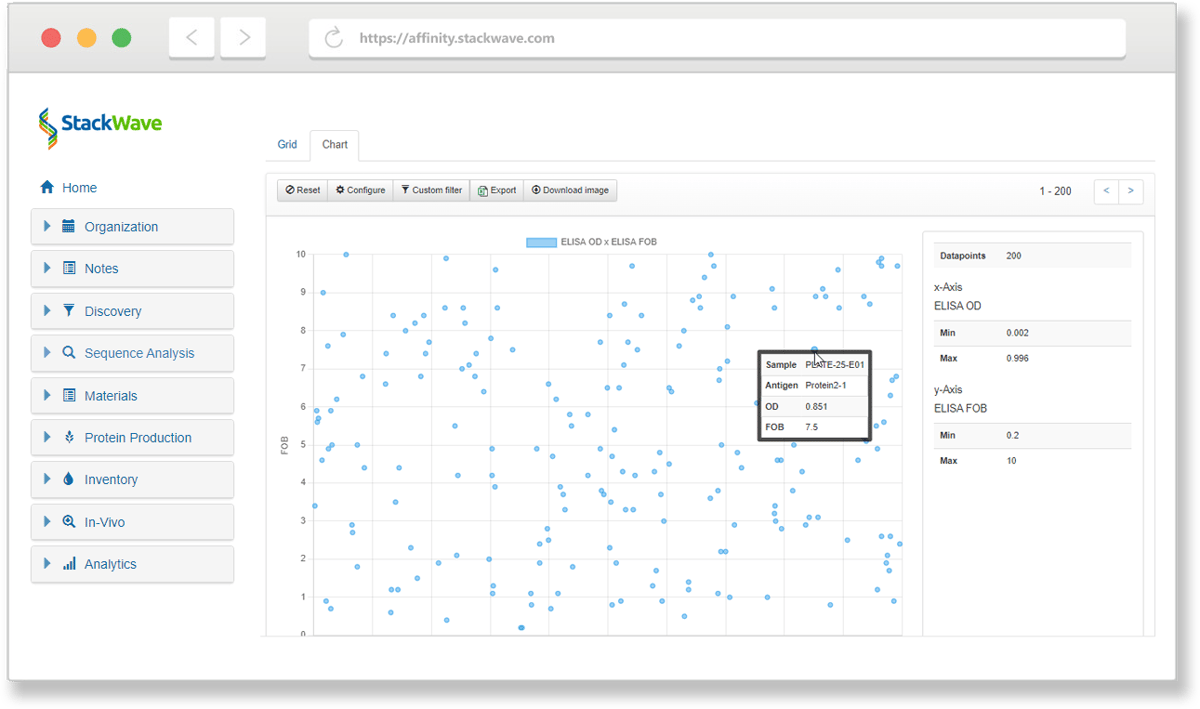
StackWave Affinity provides workflows for phage, hybridoma, and single B-cell campaigns, assay data management, sequence analysis, custom reporting, and plate generation in a single solution. These tools integrate seamlessly to help discovery teams quickly identify their most promising lead antibodies. Automation support for liquid handling platforms and assay data ingest allows for high-throughput screening of campaign results.
Hybridoma Production
Manage the complexity of hybridoma campaigns with an actual animal study management solution that connects seamlessly with hybridoma plate generation. Generated plates can be screened, sequenced, filtered, and lead antibodies identified using an intuitive set of tools that combine assay data management, sequence analysis, and custom reporting.
"StackWave gives us confidence in our leads by collecting all of the data about our potential therapeutics in one place and making that data actionable by allowing us to compare antibodies of interest."
"I worked with StackWave for ~4 years at my previous job to implement our LIMS. It was a great learning experience. We put in place an incredible system for our entire workflow, from plasmid registration to in-vivo study data registration."
"StackWave’s Platform allowed us to collaborate on our in-vivo studies in a web browser at home... I would highly recommend StackWave for therapeutic discovery teams looking to improve collaboration between teams."